
The four most effective ways to afford a home in the Twin Cities right now are negotiating seller credits to buy down your mortgage rate, asking the seller to pay closing costs, working with a buyer's agent who reads your specific submarket, and negotiating repairs or credits after the inspection. Stacked together, they can meaningfully lower both your monthly payment and the cash you need at closing.
If you are wondering how to afford a home in the Twin Cities with mortgage rates near 7%, hold that thought. The 30-year fixed rate averaged 7.03% as of September 24, 2026, up from 6.30% a year ago, according to Freddie Mac. The median Twin Cities sale price is about $408,000, according to Minneapolis Area Realtors data from July 2026.
Affordability is not one number. It is a handful of levers, and most buyers only pull one of them: the list price. Here are four ways we help our buyers pull the rest.
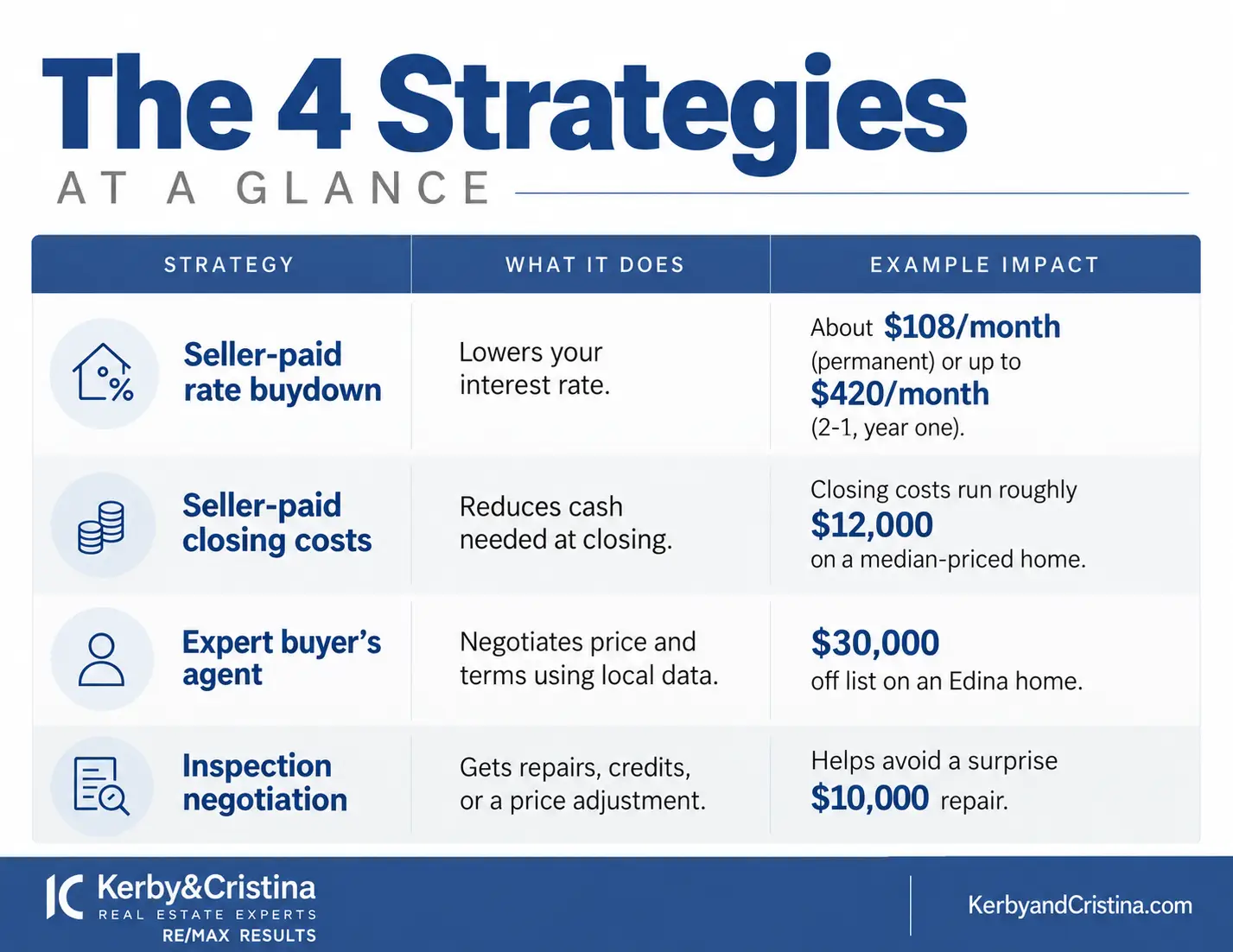
A seller can agree to a closing cost credit, and that credit can pay for discount points or a temporary buydown that lowers your interest rate.
Most buyers think of a seller concession as a discount on the house. It is also one of the most powerful tools for lowering your payment.
Here is what that can look like on a median-priced Twin Cities home ($408,238, 20% down, principal and interest only). These are illustrative numbers only and exclude taxes, insurance and any other dues like HOA dues. Your lender can run exact figures for you at the time with a real property, rates at the time and costs. For illustration purposes:
That is roughly $108 a month, about $1,300 a year, and about $39,000 over a 30-year loan. The seller did not change the price at all. One discount point costs 1% of the loan amount, about $3,300 here, and how much rate reduction each point buys varies by lender and market.
A 2-1 buydown has a different shape. Your rate is two points lower in year one and one point lower in year two before settling at the final note rate:
Total savings run about $7,600 over the first two years, so a seller credit in that range can fund the whole thing. Keep in mind that a buydown counts toward the seller contribution limits covered in the next section.
New construction is where buydowns show up most. Builders in Maple Grove, Plymouth, Rogers, and Dayton regularly offer rate buydowns, often through their preferred lender, because it protects their list prices while still making the deal work for you. Read our guide to negotiating new construction in the Twin Cities before you visit a model home, and bring your expert agent on your first visit so you are represented from day one.
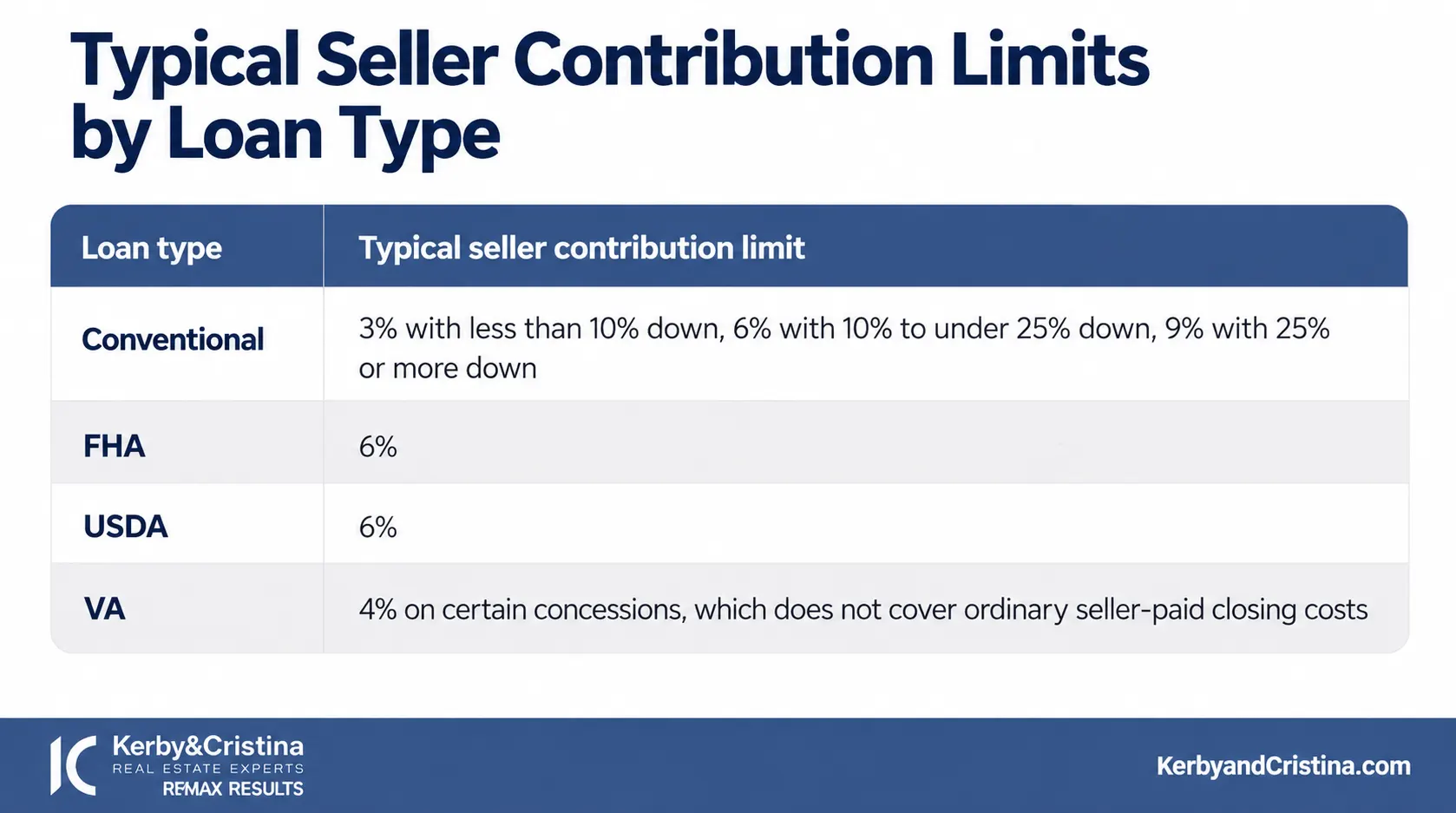
Yes. Seller-paid closing costs are common, and the maximum depends on your loan type and down payment.
Closing costs typically run around 3% of the purchase price, roughly $12,000 on a median-priced Twin Cities home. When the seller pays some or all of that, you bring less cash to closing.
Seller credits cannot be used for your down payment or required reserves, but they free up your own cash. Our buyers often use the savings to:
This is a reasonable ask in today’s market. Minneapolis Area Realtors data from August 2026 shows homes taking about 45 days to sell, with sellers accepting about 98.2% of list price.
Price and concessions are two different levers, and the best mix depends on your goals. A good agent can show you how to structure an offer so the seller nets more on paper while you still come out ahead, which makes it easier for the seller to say yes. Your lender should confirm your exact limit before we write an offer.
Often, yes, when the agent has the expertise to know how to advise and negotiate based on local supply-and-demand data instead of gut feel.
The Twin Cities is not one market. It is dozens of small ones, and what a buyer can negotiate in one neighborhood may be off the table two miles away. We explain the bigger picture in our breakdown of what today’s market means at every price point.
An expert buyer’s agent does more than pull comps. They study supply and demand in the specific submarket you are buying in: how many comparable homes are active, how long they are sitting, whether the home is drawing competition, and where the seller has real pressure.
Here is what that looks like in practice. Our agent Luka Gribenko was working with Edina buyers who had searched for about eight months and finally found their home at an open house. It was priced aggressively, so Luka asked the listing agent which comps supported the number. The answer was one sale. Luka had about five that told a very different story.
Backed by that data, the buyers went in with a low offer. The home had not received any other offers, and Luka’s research showed the sellers had already bought another home and needed to sell quickly. After ten days of negotiation, including evenings that ran until 11:30 PM, the buyers got $30,000 off list price through a combination of a price reduction and seller concessions. Luka also showed them how to structure the deal so the sellers netted more on paper while the buyers still saved significantly.
Read the full story here: Priced Off One Comp, Negotiated With Five.
That is the difference between an agent who opens doors and one who knows how to win when it counts.
Yes. In today’s more balanced market, inspection contingencies are surviving again, and buyers can often get problems addressed instead of absorbing them.
During the frenzy of recent years, plenty of buyers waived inspections or took homes as-is just to stay competitive. That meant accepting unknowns and hoping they would not turn into five-figure problems after closing.
Now, with an expert agent negotiating for you, you can often ask the seller to:
Affordability is not just what you pay to get into the house. It is also avoiding a surprise $10,000 repair six months after move-in.
None of these is a silver bullet on its own. The real savings come from stacking them: a smart negotiation on price, seller dollars used to lower your rate or your cash to close, and an inspection that protects you from expensive surprises.
With rates above where they were a year ago, seller-funded buydowns and credits matter more than they did. If you have been waiting on the sidelines, see what waiting has actually cost Twin Cities buyers.
Kerby & Cristina Real Estate Experts is the #1 REMAX Results Team and #1 REMAX Luxury Team in Minnesota. We closed 904 homes in 2025, representing more than $353 million in volume, and we have guided over 7,500 clients through this market since 2008. We know where the negotiating room is, and how to ask for it.
Tell us where you are hoping to buy, what you are comfortable paying each month, and what matters most in your next home. We will help you map out which of these strategies fit your situation, with no pressure to make a decision before you are ready.
The most effective ways are negotiating seller credits to buy down your rate, asking the seller to cover closing costs, using a buyer’s agent who reads your specific submarket, and negotiating repairs after inspection. Stacked together, these can lower both your monthly payment and the cash you need at closing.
Yes. A seller credit toward closing costs can fund discount points or a temporary buydown such as a 2-1. The cost counts toward the seller contribution limit for your loan type, so your lender should confirm the numbers before you write an offer.
It depends on your loan. Conventional loans allow 3%, 6%, or 9% depending on your down payment. FHA and USDA loans allow up to 6%. VA loans cap certain concessions at 4%. Your lender confirms your exact limit.
Often, yes. Minneapolis Area Realtors data from July 2026 shows homes taking about 40 days to sell and sellers accepting about 99.1% of list price. With more inventory and more negotiating room, seller concessions are being negotiated more often than a few years ago.
Frequently. New construction builders commonly offer rate buydowns, closing cost credits, and design center allowances, especially when a community is nearing sellout. Register with your buyer’s agent on your first visit to make sure you are represented from day one.
We strongly recommend it. An inspection shows you what you are buying and gives your agent leverage to negotiate repairs, credits, or a price adjustment on issues that buyers in tighter markets often had to accept.
It varies by home and market. In one recent Edina purchase, our agent Luka Gribenko negotiated $30,000 off list price through a price reduction and seller concessions, after showing that the listing price rested on a single comp.
Sources: Freddie Mac Primary Mortgage Market Survey | Fannie Mae Selling Guide: Interested Party Contributions | Minneapolis Area Realtors (July 2026). Payment examples are illustrative principal-and-interest estimates, not a loan offer.