
If you paused your home search last summer to wait for better mortgage rates, here is what that decision actually bought you.
Last August, the average 30-year fixed rate was 6.58%. As of August 13, 2026, it is 6.67%. Rates went up, not down.
In that same stretch, the median sale price in the Twin Cities climbed from $395,000 to $408,238.
So a year of patience produced a slightly higher rate and a home that costs $13,238 more. That is the part nobody warns you about when they tell you to wait it out.
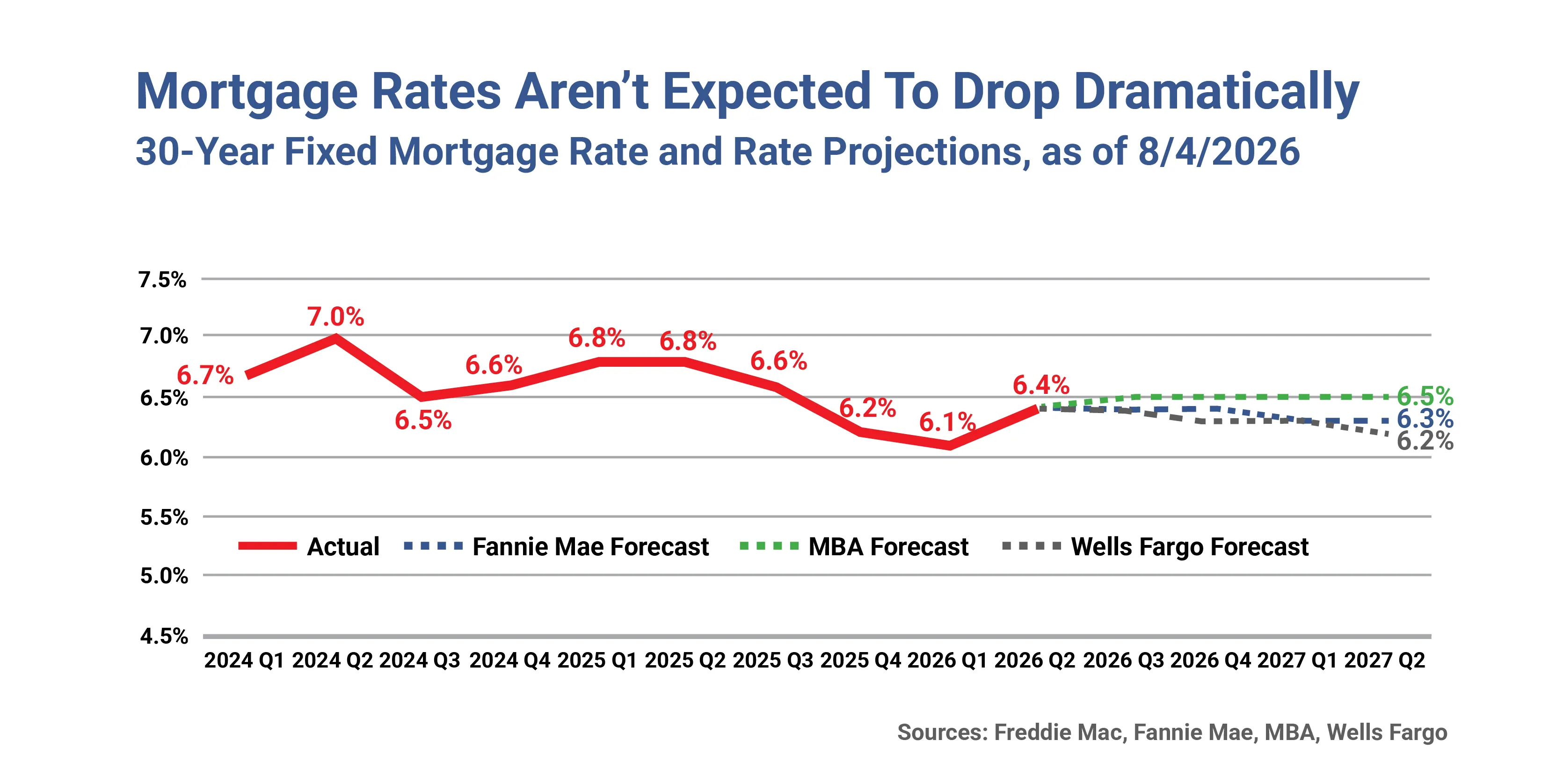
Probably not, if you are otherwise ready to buy. Fannie Mae, the Mortgage Bankers Association, and Wells Fargo all forecast the 30-year fixed rate staying in the low-to-mid 6% range through at least mid-2027. Meanwhile, Twin Cities home prices are still rising about 3% a year. Waiting for a rate drop that forecasters do not see coming usually means paying more for the same house, with more competition when you finally do buy.
Below is the full picture, including four ways our buyers are lowering their payment right now without waiting on the Fed.
Let’s run a Twin Cities buyer through it. Median-priced home, 20% down, principal and interest only.
| Purchase price: $395,000 |
| Down payment: $79,000 |
| Rate: 6.58% |
| Monthly payment: about $2,014 |
| Purchase price: $408,238 |
| Down payment: $81,648 |
| Rate: 6.67% |
| Monthly payment: about $2,101 |
That is roughly $87 more per month, about $1,044 more per year, and $2,648 more cash needed at closing. The buyer who moved last summer is also sitting on around $13,000 in equity that the waiting buyer does not have.
Now stretch that over the life of the loan. The same house, bought a year later, costs about $31,000 more in payments over 30 years. Nothing about the house changed. Only the timing did.
A recent Clever survey found that 42% of buyers believe rates will fall below 5% this year. The people who model this for a living disagree, and it is not close.
Fannie Mae, the Mortgage Bankers Association, and Wells Fargo all project rates holding in the low-to-mid 6% range into 2027. Mortgage rates are pulled by inflation, Treasury yields, Federal Reserve policy, and global events. Right now none of those are pointing toward a dramatic drop.
Inflation is the sticking point. After a stable run from mid-2023 into late 2025, inflation has been trending higher again. High inflation and low mortgage rates rarely coexist. The main ingredient needed for a meaningful rate decline simply is not in place.
Could rates drift down a quarter point? Sure. They ticked from 6.69% to 6.67% the first week of August. But drifting is not the same as dropping, and a quarter point on a $400,000 loan is roughly $60 a month. That is not the windfall people are picturing when they say they are waiting.
This is the mental reset that helps most of our buyers.
Freddie Mac has tracked mortgage rates since 1971. Across that entire history, rates have spent most of their time between roughly 5% and 10%. A 6.67% rate sits comfortably inside the normal band. It only feels high if we have neighbors or friends who locked 3% during the pandemic.
Those pandemic rates were the anomaly. Building a homebuying plan around their return is like waiting for lakefront in Minnetonka to get cheap again.
Here is what we see in the Twin Cities right now, from Minneapolis Area Realtors data for the week ending August 8:
Read those together and you get a market with more choices and less urgency than we have seen in years, reflecting a trend towards a more balanced market. Buyers are negotiating. Inspection contingencies are surviving. Sellers are covering closing costs again. We wrote more about this shift in our balanced market guide.
Now picture the day rates fall to 5.5%. Every buyer currently parked on the sidelines comes back at once. Inventory that took 40 days to sell starts selling in 10. Multiple offers return. The negotiating leverage you have today evaporates, and it evaporates faster than prices can adjust.
Cheaper money does not make homes cheaper. It makes buyers braver, and braver buyers bid against each other. If you want a preview of what that looks like, read how our buyers win in multiple offers.
The other pressure worth knowing: the lock-in effect. Homeowners holding 3% mortgages are still reluctant to list, which keeps a lid on supply. When rates drop enough to unfreeze those sellers, buyers unfreeze first. Demand comes back before inventory does.
You do not have to accept 6.67% just because it is the headline number. Here is what is actually working.
1. New construction incentives. This is the biggest opportunity in our market at the moment, especially in the northwest metro. Builders in Maple Grove, Plymouth, Corcoran, Rogers, and Dayton are competing hard for buyers with rate buydowns, closing cost credits, free upgrades, and price reductions on standing inventory. One of our buyers recently landed the last floorplan in her community and negotiated $10,000 off the price. We broke down the full playbook in our guide to negotiating new construction in the Twin Cities. And many builders are offering rates between 5-6% for buyers who use their lenders.
2. Rate buydowns. You pay money upfront, either out of pocket or through a seller credit, to lower your rate. A 2-1 buydown cuts your rate by two points in year one and one point in year two before settling at the note rate. With sellers accepting 99.1% of list and homes sitting 40 days, seller-paid buydowns are very much on the table right now, particularly in Minneapolis and St. Paul where inventory has loosened most.
3. Adjustable-rate mortgages. If you know you are moving again in five to seven years, an ARM can start below a 30-year fixed. It is not for everyone and it is not free of risk, but it deserves a conversation with your lender rather than an automatic no.
4. Assumable mortgages. FHA and VA loans can be assumed, meaning you take over the seller’s existing loan at their original rate. The catch is scale: FHA financing made up roughly 6.5% of recent Twin Cities closings, so the pool is small. When one surfaces with a 4% note attached, it is worth moving fast.
Worth noting: about 17.3% of recent Twin Cities closings were all cash. Roughly one in six buyers you compete against does not care about mortgage rates at all.
The right move changes by market, and this is where a metro-wide average stops being useful.
Plymouth, Maple Grove, and the northwest metro have the most active new construction, which means the most builder incentives. If a rate buydown is your priority, this is where you will find it handed to you.
Minneapolis and St. Paul are where inventory has expanded most, and that translates into seller-paid closing costs and buydowns on resale homes.
Edina and Minnetonka are established markets with limited new construction, so leverage comes from days on market and pricing strategy rather than builder incentives. Well-priced homes here still move quickly. Overpriced ones sit, and that is where negotiation happens.
If you are still narrowing down where to look, our Twin Cities neighborhood guide walks through the tradeoffs.
If your life is genuinely not ready for a move, wait. Build savings, fix your credit, finish the job transition. Those are good reasons.
But if you are waiting purely because you think rates are about to fall, the forecasts, the inflation data, and the last twelve months of Twin Cities numbers all point the same direction. You are likely to pay more later for the house you could buy today, and you will pay it in a more crowded market.
Kerby & Cristina Real Estate Experts is the #1 REMAX Results Team and #1 REMAX Luxury Team in Minnesota. We closed 904 homes in 2025, representing more than $353 million in volume, and we have guided over 7,500 clients through this market since 2008. We have watched buyers wait through several rate cycles, and we can tell you honestly which ones were worth waiting through.
Let us run your actual numbers. Not a national average, your price range, your suburb, your down payment, your timeline. Then decide.
Almost certainly not. Fannie Mae, the Mortgage Bankers Association, and Wells Fargo all forecast the 30-year fixed rate holding in the low-to-mid 6% range through at least mid-2027. Rates averaged 6.67% as of August 13, 2026. A drop below 5% would require a significant economic shift that no major forecaster is currently predicting.
Based on the last twelve months, waiting cost money. The Twin Cities median sale price rose from $395,000 in July 2025 to $408,238 in July 2026, while the average 30-year rate moved from 6.58% to 6.67%. A buyer who waited faces a higher price, a slightly higher rate, and a larger down payment.
The Minneapolis Area Realtors Housing Affordability Index registered 115 in July 2026, down from 118 a year earlier. An index of 115 means the median household income is 115% of what is needed to qualify for the median-priced home at prevailing rates. Affordability is tightening slowly, not improving.
For buyers who are financially ready, conditions are the most favorable they have been in several years. Twin Cities inventory is up 8.2% year over year, months supply reached 3.0, homes take 40 days to sell, and sellers are accepting 99.1% of original list price. That combination gives buyers real negotiating room.
Yes. You are marrying the house and dating the rate. If rates fall meaningfully, refinancing lets you keep the price you locked in today and swap the rate later. What you cannot refinance is a purchase price, and prices are the thing currently moving up.