
Your St. Paul home value depends more on your neighborhood than on almost any other factor. The citywide median sale price in St. Paul is $300,000 as of September 2026, but average sale prices by neighborhood range from $218,975 Downtown to $680,628 in Summit Hill. Summit Hill’s average is nearly three times that of Dayton’s Bluff ($245,056). To get an accurate number, start with your neighborhood’s recent sales, then adjust for condition, size, and updates.
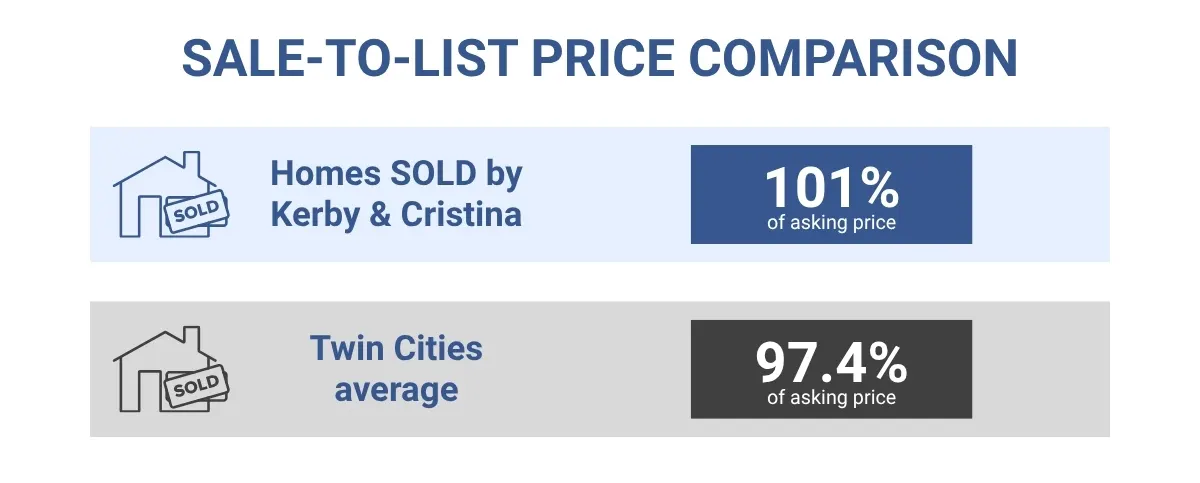
How you sell matters too. Kerby & Cristina listings sell for 101% of list price on average, compared with a Twin Cities average of 97.4% in 2025.
| Metric (September 2026) | St. Paul | Twin Cities Region |
|---|---|---|
| Median sale price | $300,000 | About $395,000 |
| Homes for sale | 581 | 10,388 |
| Months supply of inventory | 2.6 | 2.7 |
| Pending sales (rolling 12 months) | 2,638 | 46,489 |
| Average % of original list price received | 98.7% | 98.4% |
| Median days on market | 21 | 24 |
Source: NorthstarMLS
St. Paul’s months of supply has climbed from 1.4 in January 2023 to 2.6 today. Buyers have more choices than two years ago, but St. Paul sellers still receive a slightly higher share of their original list price (98.7%) than sellers across the region (98.4%), and St. Paul homes sell faster, at a median of 21 days on market versus 24 regionally.
For a side-by-side look at the other half of the metro, see our Minneapolis home value neighborhood guide and our breakdown of Minneapolis vs. suburbs home value growth in 2026.
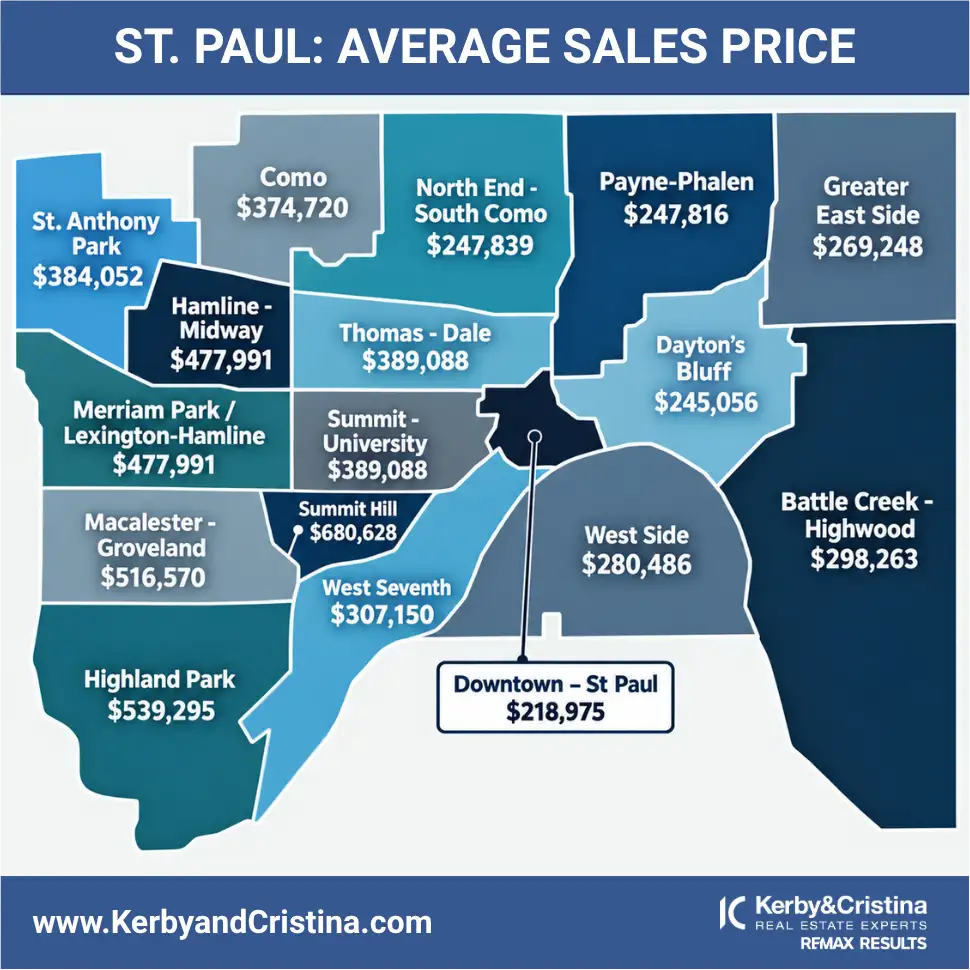
St. Paul home prices by neighborhood range from an average of $218,975 Downtown to $680,628 in Summit Hill, a spread of more than $460,000. Four neighborhoods average above $475,000, four sit between $300,000 and $400,000, and seven average under $300,000.
| Neighborhood | Average Sale Price | Price Tier | Typical Housing |
|---|---|---|---|
| Summit Hill (incl. Crocus Hill) | $680,628 | Upper | Victorian and early 1900s homes near Grand Ave and Summit Ave |
| Highland Park | $539,295 | Upper | Mid-century and traditional homes, plus Highland Bridge new construction |
| Macalester-Groveland | $516,570 | Upper | Craftsman, Colonial, and Tudor homes near the colleges |
| Merriam Park / Lexington-Hamline | $477,991 | Upper | Foursquares and bungalows near the Green Line |
| Summit-University | $389,088 | Mid | Victorian homes and rowhouses along Selby Ave |
| St. Anthony Park | $384,052 | Mid | Wooded, hilly lots with early 1900s homes |
| Como | $374,720 | Mid | Bungalows and 1920s to 1950s homes near Como Lake |
| West Seventh | $307,150 | Mid | Older homes and newer townhomes near the river and downtown |
| Battle Creek / Highwood | $298,263 | Entry | Post-war and suburban-style homes, larger lots |
| West Side | $280,486 | Entry | Older homes with downtown and river bluff views |
| Greater East Side | $269,248 | Entry | Post-war ramblers and bungalows |
| North End | $247,839 | Entry | Older single-family homes near Rice Street |
| Payne-Phalen | $247,816 | Entry | Older homes near Lake Phalen |
| Dayton’s Bluff | $245,056 | Entry | Historic Victorians at accessible prices |
| Downtown St. Paul | $218,975 | Entry | Condos and lofts, including Lowertown |
Average sale prices for September 2026. Source: NorthstarMLS. Downtown sales are mostly condos, so its average runs lower than single-family neighborhoods.
After neighborhood, St. Paul home values are driven mainly by condition, updates, size, and proximity to amenities. Because so much of St. Paul’s housing stock was built before 1940, the gap between an updated home and an original-condition home on the same street can be significant.
The factors that move value most:
The most accurate home value estimate in St. Paul, MN comes from a local comparative market analysis (CMA) based on recent sales in your specific neighborhood, not an online algorithm. Automated estimates often miss condition, updates, and the sharp price changes between neighboring St. Paul areas.
How to estimate your St. Paul home value:
If you are weighing whether to sell or hold, our post on renting vs. selling your Twin Cities home walks through that decision.
St. Paul has one of the widest neighborhood price spreads in the Twin Cities because its historic, river-adjacent neighborhoods and its older working-class neighborhoods developed side by side, often only a few miles apart. The average sale price in Summit Hill ($680,628) is $435,572 higher than in Dayton’s Bluff ($245,056). Even neighbors diverge: Summit-University averages $389,088, which is $291,540 less than adjacent Summit Hill.
What creates St. Paul’s unusually wide spread:
Because comparable sales can change sharply from one neighborhood boundary to the next, pricing a St. Paul home correctly takes hyper-local knowledge. Price off the wrong comps and you either leave money on the table or sit on the market.
That is where strategy shows up in the numbers. Kerby & Cristina listings sell for 101% of list price on average, compared with the Twin Cities average of 97.4% in 2025. On a $300,000 home, the St. Paul median sale price, that 3.6-point difference equals roughly $10,800 more at closing.
You can see the results for yourself on our sold homes page, or read how our team was named a top 3 REMAX team in the nation.
Your St. Paul home value comes down to your neighborhood first, then condition, updates, and how your home is priced and marketed. With such a wide price spread across the city, a neighborhood-specific analysis is the only reliable way to know your number.
Kerby & Cristina listings sell for 101% of list price on average, versus 97.4% across the Twin Cities in 2025.
If you are curious what your home could sell for, request your free St. Paul home evaluation or call us at 763-634-0073.
Thinking about timing? Read why fall can be a smart time to sell in the Twin Cities.
Your St. Paul home is worth what comparable homes in your neighborhood have recently sold for, adjusted for condition, size, and updates. The fastest accurate answer is a free comparative market analysis from a local agent.
The median sale price in St. Paul is $300,000 as of September 2026. Average sale prices by neighborhood range from $218,975 Downtown to $680,628 in Summit Hill, with most neighborhoods between $245,000 and $540,000.
Summit Hill (680,628),HighlandPark(539,295), Macalester-Groveland (516,570),andMerriamPark/Lexington-Hamline(477,991) have the highest average sale prices in St. Paul. Historic architecture, river access, and walkable corridors like Grand Avenue drive those prices.
Online estimates are often off in St. Paul because they cannot see condition or updates and struggle with sharp price changes between neighborhoods. Use them as a rough starting point and confirm with a local CMA.
St. Paul still leans toward sellers in 2026, with 2.6 months of supply as of September 2026, below the 4 to 6 months commonly considered balanced. Inventory has risen steadily since 2023, though, so accurate pricing and strong preparation matter more than they did a few years ago.